

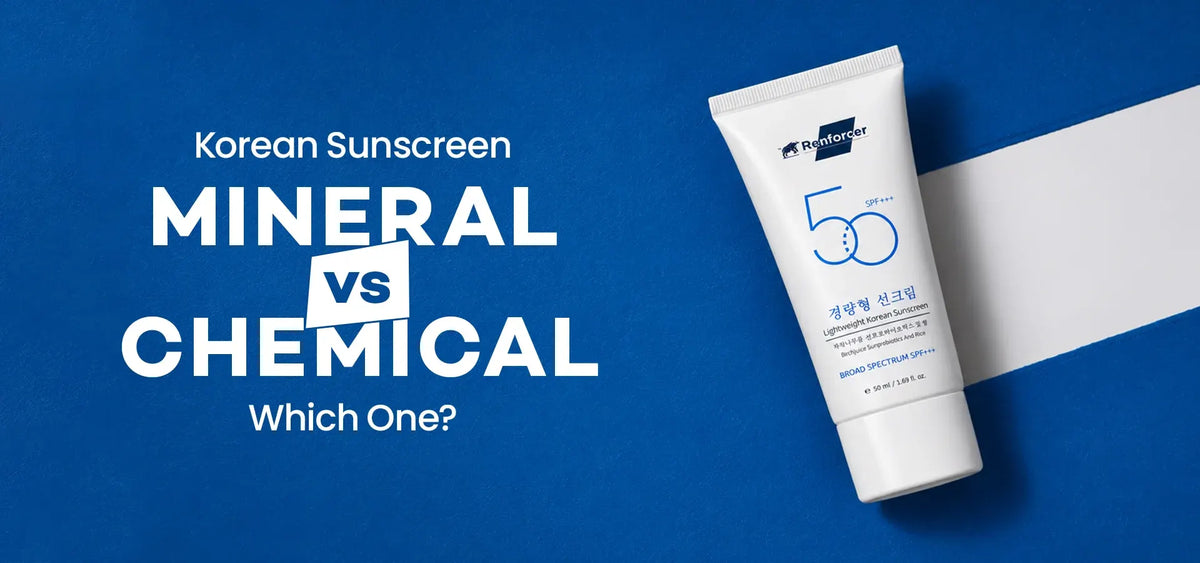
Korean Mineral Sunscreen vs Chemical Sunscreen: Which One?
You’ve probably heard that mineral sunscreen is “safer” and chemical sunscreen is “lighter”... but the truth is more complex, especially in K-beauty. Plenty of Korean mineral sunscreens don't look chalky anymore, and plenty of chemical ones sit comfortably on sensitive skin.
So which one actually belongs in your routine? In this post, we’ll break down how Korean mineral and chemical sunscreens differ, who each type suits best, and how to choose without falling for outdated myths.
Mineral vs Chemical SPF: What's Actually Different?
The difference lies in the UV filters, the active ingredients that do the actual blocking. Side by side, the two types look like this:
|
Mineral sunscreen |
Chemical sunscreen |
|
Uses zinc oxide and titanium dioxide |
Uses avobenzone, bemotrizinol, and other organic filters |
|
Creamy lotion or milky fluid texture |
Watery gel, essence, or light serum texture |
|
May leave a white cast on deeper skin tones |
Rarely leaves a white cast |
|
Gentlest for sensitive or easily irritated skin |
Best for calm skin that wants an invisible finish |
Not sure which one you're holding? Flip the box over and check the active ingredients. It takes about five seconds:
-
Only zinc oxide or titanium dioxide? It's mineral.
-
Neither of those? It's chemical.
-
A mix of both? It's a hybrid.
While you're reading the label, you'll notice Korean tubes list two ratings: SPF and PA. Each one covers a different kind of UV, and here's what they mean:
|
On the label |
What it tells you |
|
SPF |
Protection from UVB, the rays behind sunburn |
|
PA+++ |
High protection from UVA, the rays tied to dark spots and early wrinkles |
|
PA++++ |
The top UVA grade |
|
Broad spectrum (US) |
UVA is covered, but the level isn't graded |
Why a Korean Mineral Sunscreen Feels Different
If your last zinc sunscreen felt like spreading thick paint, Korean versions deserve another look. The upgrade comes down to how they're made:
-
Finer zinc. Many use very fine, coated particles, so the cream glides on evenly instead of streaking.
-
Skincare bases. Korea treats sunscreen as a functional cosmetic, so brands add centella asiatica and ceramides to the same tube.
-
Softer textures. Expect milky fluids and cushiony creams with a skin-soft finish.
That's why Korean sunscreens get compared to moisturizers so often. If you want a mineral-based sunscreen, Korean brands tend to offer the softest finish around.
Quick tip: some tubes say "mineral" on the front but add chemical filters to push the SPF higher. That makes them hybrids, so always read the active ingredients.
What Makes a Korean Chemical Sunscreen So Light?
Better filters, mostly. A Korean chemical sunscreen can use bemotrizinol (also sold as Tinosorb S) or Uvinul A Plus. Because these filters cover a wide UV range at lower amounts, the formula can stay thin, closer to a water-light essence that disappears after a few pats than a lotion you have to rub in.
Two recent developments matter here, one about access and one about safety:
-
New in the US. The FDA has been slow to approve these newer UV filters. The approved list finally grew in June 2026, when US regulators cleared bemotrizinol for use in sunscreen. Before it, no new UV filter had joined the list for over 20 years. Babies as young as 6 months can use it, too.
-
The absorption study. In a 2020 FDA study in JAMA, 48 adults applied sunscreen to 75% of their bodies. Six common chemical filters, including avobenzone and oxybenzone, showed up in their blood above the FDA's screening level after one use. The FDA said this doesn't make them unsafe. It means more testing is needed.
If that open question bothers you, zinc oxide is an easy swap. Otherwise, a chemical formula you wear every day still beats a mineral one sitting in a drawer.
Which One Fits Your Skin Type?

Find the row that sounds most like you.
|
If your skin is... |
Start with |
|
Sensitive, red, or easily stung |
Mineral, with zinc oxide |
|
Oily or acne-prone |
Either type, as long as it's lightweight and non-comedogenic |
|
Dry or tight |
Either type, with ceramides or birch juice for moisture |
|
Medium to deep in tone |
Chemical, or a sheer mineral made for no white cast |
|
Prone to dark spots or melasma |
A tinted mineral with iron oxides |
|
Wearing makeup daily |
A thin chemical fluid or a soft-finish mineral cream |
|
Sweating or swimming |
Any type labeled water-resistant |
A few extra pointers:
-
Rosacea or a barrier that feels raw from retinoids? Zinc oxide usually feels calmer. Our picks for sensitive skin lean mineral for that reason.
-
Face feels tight after SPF? Choose an alcohol-free formula.
-
Fighting melasma? Visible light can darken it too, and clear sunscreens (sheer zinc included) don't block it. Iron oxides in tinted formulas do.
-
Pool day or summer run? Check the back of the tube for a 40- or 80-minute claim. Only a water-resistant formula carries one, and it tells you how long protection lasts while you sweat or swim.
Sunscreen Myths
A few things people repeat about sunscreen don't match the research:
-
"Mineral sunscreen bounces UV away like a mirror." Zinc and titanium reflect only 4 to 5% of UV, per a 2016 study. The rest of their protection comes from soaking up UV, which is the same basic job chemical filters do.
-
"Mineral works instantly, so you can skip the wait." Dermatologists advise applying any sunscreen about 15 minutes before going outside.
-
"Higher SPF means you can reapply less." SPF 50 blocks a bit more UVB than SPF 30, but it doesn't last any longer on your skin.
In practice, then, your choice comes down to comfort and how your skin reacts.
Our Pick: Beauty of Renforcer Lightweight Korean Sunscreen

Leaning mineral but nervous about a heavy, chalky layer? Try the Beauty of Renforcer Lightweight Korean Sunscreen SPF 50+ PA+++. It feels like a light cream that sinks in quickly, with no sticky finish and no white cast.
Here's what's inside:
-
Zinc oxide works as the mineral filter, guarding skin from both UVA and UVB rays
-
Birch juice and rice ferment filtrate for all-day hydration
-
Centella asiatica to help calm redness
-
Ceramide NP to support your skin barrier, the outer layer that keeps moisture in
-
No alcohol, so it's comfortable on dry and sensitive skin
It's made for every skin type, including acne-prone.
To get the full SPF from every application:
Measure about 1 teaspoon for your face. The American Academy of Dermatology notes that SPF 30 blocks 97% of UVB rays, yet many people apply only 20 to 50% of the amount they need.
Apply it as the last step of your morning routine, about 15 minutes before heading out.
Reapply on a two-hour cycle whenever you're outside. Towel-drying after a swim or a sweaty workout wipes some off, so top up then too.
FAQs
Should sensitive skin stick with Korean mineral sunscreen?
Yes, in most cases. Dermatologists often suggest zinc oxide and titanium dioxide for sensitive skin because they rarely irritate.
Does Korean mineral sunscreen leave a white cast?
Much less than older formulas. On deeper skin tones, look for "no white cast" or tinted options and test on your jawline first. Skip "tone-up" formulas if you want zero cast, since they brighten skin on purpose.
Are most Korean sunscreens chemical or mineral?
Mostly chemical. A Korean chemical sunscreen is the everyday favorite in Korea for its weightless feel, but mineral and hybrid options are easy to find. Both differ from Western sunscreens mainly in filters and texture.
Can I layer a mineral sunscreen over a chemical one?
You can, but the SPF numbers don't add together. Applying one product generously matters more.
Is mineral sunscreen reef-safe?
It's the safer bet. Hawaii has banned sunscreens with oxybenzone and octinoxate since 2021, and mineral formulas contain neither. "Reef safe" isn't a regulated claim, though, so read the active ingredients.
So, Which Should You Choose?
Still torn? Start with a Korean mineral sunscreen and wear a full teaspoon every morning for two weeks. Check how your skin feels by mid-afternoon and how the finish looks in daylight.
If it passes both tests, you've found your daily SPF. If your skin stays calm but you miss a weightless feel, a chemical formula is an easy next step.